Switchboards April 2026 · 5 min read
Older switchboards in New Zealand are often missing safety features that are now standard practice. If you are replacing, upgrading, or specifying a new switchboard, here are six things every safe, modern installation must include.
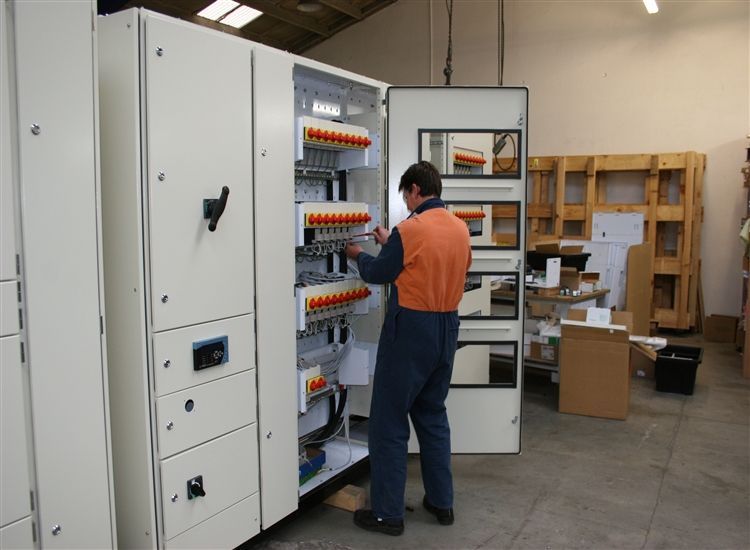
New Zealand’s electrical safety standards have evolved significantly over the past 20 years, and so has the technology available to protect people and equipment. A switchboard built in 2005 to the standards of the time may be missing several features that are now considered standard practice for AS/NZS 3000 and AS/NZS 61439 compliance and for genuine workplace safety. At Clive Wilson Switchboards, these six features are part of every modern build we deliver.
A type-tested switchboard assembly has been independently verified to meet the performance requirements of AS/NZS 61439 through rigorous testing of a reference design. This covers temperature rise limits, dielectric properties, short-circuit withstand, and protection against ingress. At Clive Wilson, we build on the Simotrol type-tested platform, giving clients documented evidence of compliance rather than reliance on calculation alone. This is important for insurance, compliance audits, and accountability when faults occur.
RCDs (residual current devices) and their combined equivalents, RCBOs (residual current circuit breakers with overcurrent), protect people from electric shock caused by earth leakage. AS/NZS 3000 requires RCD protection on final circuits in most NZ installations. A modern switchboard should have RCDs or RCBOs on all socket outlet circuits and on circuits supplying portable equipment, and should comply with the relevant clauses of AS/NZS 3000 for the installation type. Older boards without RCD protection on final circuits represent a genuine safety deficit.
Surge protection devices protect connected equipment from transient overvoltages caused by lightning strikes, network switching events, and large motor starts. AS/NZS 3000 now requires SPDs in specified installation types, and they are increasingly expected on all commercial and industrial switchboards. A single lightning strike on the network without surge protection can destroy sensitive electronic equipment across an entire facility. SPDs are one of the most cost-effective protections a switchboard can include relative to the equipment they protect.
Every circuit in a switchboard must be permanently and legibly identified. AS/NZS 3000 clause 8.9 is explicit on this. Labels that peel, fade, or are illegible after years of service are not compliant. Modern best practice is laser-engraved stainless steel labels on each circuit, identifying the circuit name, the load served, and the protective device rating. At Clive Wilson, we produce these in-house using our precision laser engraving capability, ensuring every label is permanent and exactly matched to the as-built drawing.
Every circuit breaker and fuse in a switchboard must have a rated breaking capacity at least equal to the prospective short circuit current (PSCC) at the point of installation. Undersized breaking capacity is a hidden safety hazard: a fault exceeding the breaker’s rating can result in an explosion rather than a controlled trip. The PSCC must be calculated for the installation from the network supply data, and all protective devices must be verified against that figure. Older switchboards, or boards specified without proper fault level calculations, frequently have undersized devices.
A switchboard without any metering gives the building owner no visibility over electricity consumption, power factor, or energy quality. Installing an energy meter at the main incomer as a minimum provides total consumption data, power factor readings, and a baseline for energy management. For commercial and industrial clients, this data is increasingly required for sustainability reporting and cost allocation. Smart meters with communications output (Modbus TCP) allow the data to be read remotely and integrated with a BMS or energy management platform.
Related reading:
Talk to us about upgrading or replacing your NZ switchboard
📍 31-33 Clyde Street, Invercargill · 📞 +64 3-214 4264