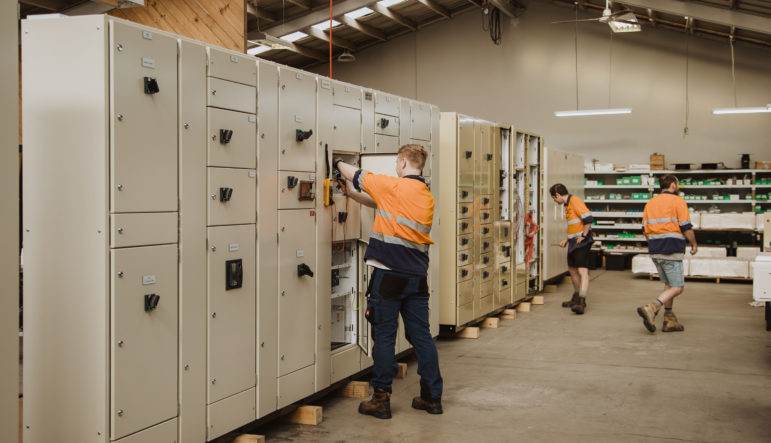
Your switchboard is the heart of your facility's electrical system. When it works, nobody notices. When it fails, everything stops. For industrial and commercial facilities across New Zealand, unplanned switchboard failure isn't just inconvenient — it's expensive, potentially dangerous, and in some cases a compliance issue under the Health and Safety at Work Act 2015 and WorkSafe New Zealand electrical regulations.
As switchboard manufacturers with over 50 years of experience, we see first-hand how well-maintained boards perform over decades — and what happens to the ones that aren't. This guide covers what regular switchboard maintenance involves, why it matters, and what to look for before a problem becomes a breakdown.
Understanding what you're maintaining matters. A modern industrial switchboard is made up of several interdependent components, each with its own failure modes:
The most common reason switchboard maintenance gets deferred is that the board appears to be working fine. Switchboards don't typically give obvious warning signs before failure. Heat builds slowly. Connections loosen incrementally. Insulation degrades over years, not overnight.
By the time a symptom is visible — a tripped breaker, a burnt smell, a warm panel face — the underlying issue has often been developing for months. At that point, you're no longer doing maintenance. You're doing emergency repair, with all the downtime, cost, and safety risk that comes with it.
A structured switchboard maintenance programme covers five core activities. Each targets a specific failure mode that visual inspection alone will never catch.
A thermal imaging inspection — also called infrared thermography — uses a thermal camera to detect heat differentials across busbars, connections, breakers, and cable terminations while the switchboard is live and under load. Hot spots that are completely invisible to the naked eye show up clearly on a thermal image. This is one of the single highest-value maintenance activities for any industrial switchboard, because it identifies resistance heating caused by loose connections or failing components before they escalate into a fault or fire. Thermal imaging inspections should be carried out at least annually on heavy industrial switchboards, and every six months on mission-critical installations.
Busbars are bolted copper conductors, and bolted connections loosen over time due to the repeated thermal expansion and contraction that occurs every time load changes. Busbar torque testing — re-torquing all bolted busbar connections to the manufacturer's specified values — is a straightforward but critical maintenance task that directly prevents the most common cause of switchboard fires. It should be carried out whenever the switchboard is de-energised for maintenance, and as a minimum every two to three years depending on the load cycling of the facility.
An arc flash inspection assesses the switchboard's arc flash hazard level — the incident energy (measured in cal/cm²) that would be released at the worker's position in the event of an arc flash event. This matters for two reasons: first, it determines the PPE required for anyone working on or near the live switchboard; and second, changes to the upstream supply network or additions of new loads can increase the fault level at your site, which may invalidate a previous arc flash assessment. Any facility operating under the Health and Safety at Work Act 2015 has a duty to manage this hazard. If your switchboard has never had a formal arc flash study, or if site conditions have changed since the last one, it needs to be reviewed.
Circuit breakers are mechanical devices, and like all mechanical devices they degrade with age and use. Breaker testing verifies that each breaker will trip correctly at the current it is rated for — something that cannot be assumed simply because the breaker hasn't tripped recently. In fact, breakers that are never called upon to operate are often the ones that fail to trip when they're needed most. Breaker testing intervals depend on the breaker type, age, and manufacturer guidance, but as a general rule industrial switchboard breakers should be functionally tested every three to five years, with older or high-cycle breakers tested more frequently.
Insulation resistance testing — sometimes called a megger test — applies a DC test voltage across the insulation of cables and busbars to measure how well the insulation is resisting current flow. Healthy insulation should show a very high resistance value (typically hundreds of megaohms or higher). A declining trend in insulation resistance readings over successive tests is a reliable early indicator of insulation breakdown, moisture ingress, or contamination — all of which can lead to earth faults or phase-to-phase faults if left unchecked. Insulation resistance test results should always be recorded and trended over time — a single reading in isolation tells you far less than a series of readings taken at consistent intervals.
Maintenance frequency depends on the age of the switchboard, the operating environment, and the criticality of the loads being served. Use this as a starting point:
| Switchboard Type / Environment | Recommended Inspection Interval |
|---|---|
| Clean commercial environment | Every 2–3 years |
| Light industrial | Every 12–24 months |
| Heavy industrial, dusty or humid | Every 6–12 months |
| Mission-critical (data centres, hospitals) | Every 6 months or per asset management plan |
| Switchboards over 20 years old | Annual minimum, regardless of environment |
The financial case for regular switchboard maintenance is straightforward:
For a manufacturing or processing facility, even a few hours of unplanned downtime can dwarf years of maintenance costs. At Clive Wilson, we design every switchboard to a projected 25-year service life — but that lifespan assumes the board is properly maintained throughout.
If your switchboard is approaching or beyond 20 years old, maintenance alone may not be sufficient. Consider a formal switchboard condition assessment by a qualified electrical engineer. Key questions to ask:
If the answer to any of these is uncertain, get a professional assessment before waiting for a failure to force the issue.
At Clive Wilson Switchboards, we design every assembly with maintainability in mind. Clear cable segregation, labelled components, accurate as-built documentation, and appropriate access clearances are built into every board we manufacture — not added as an afterthought. When you specify a Clive Wilson switchboard, you're getting a fully documented, verified assembly that your maintenance team can work with safely for decades.
Whether you're planning a new installation, assessing an ageing switchboard, or specifying a replacement — our team is here to help.