
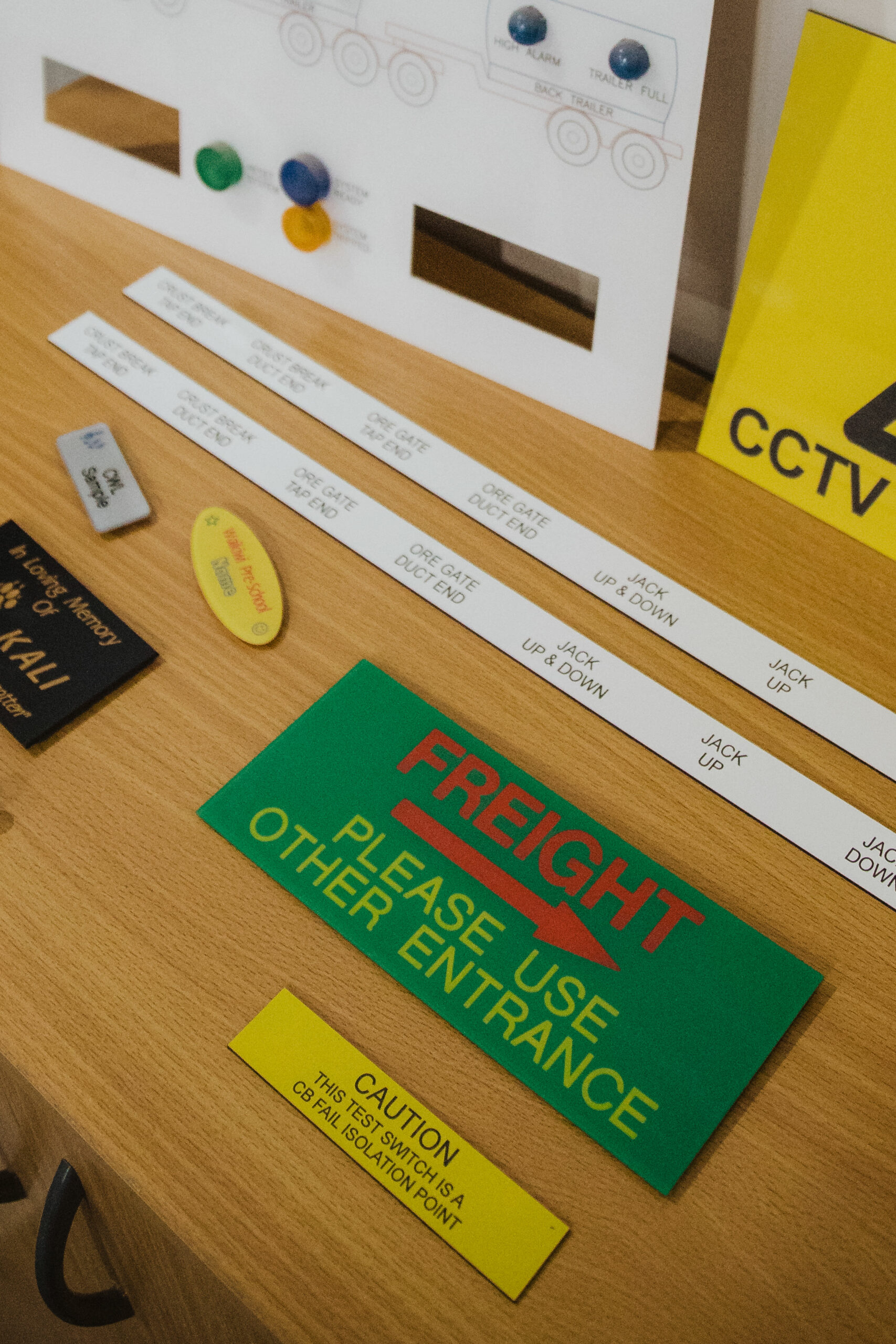
Clive Wilson Engraving has produced labels and identification in Invercargill since 1972. We laser-engrave laminate labels and use rotary engraving for metal plates. A clear schedule keeps equipment tags, drawings and the finished labels aligned.
Start with the information people need
A label may identify a circuit, give an operating instruction, link an asset to a register or record equipment characteristics. Decide its purpose before choosing a material or size.
Circuit names and asset tags need to match the drawings and schedules. Avoid abbreviations that make sense only to the person who ordered the label. When there are many labels, a controlled spreadsheet is usually clearer than text scattered across emails.
Four common applications
| Application | Details to resolve |
|---|---|
| Circuit and control legends | Exact text, device reference, viewing distance and layout. |
| Equipment plates | Required fields, declared data, dimensions and authorised content. |
| Asset tags | Unique ID, numbering rules, location and register ownership. |
| Instructions and signs | Approved wording, symbols, contrast and exposure. |
For CWS switchboards, nameplate data comes from the assembly design records. For other equipment, supply the approved wording and ratings with the label schedule so the proof can be checked before engraving.
Choose the whole label system
Laser-engraved laminate suits many control legends and electrical labels. Rotary engraving is available for metal plates. Select the material, contrast and mounting for sunlight, moisture and the cleaning chemicals used at the site.
Fixing matters too: holes, adhesive, fasteners and mounting surfaces must suit the environment and equipment. No mark or label is universally permanent under every exposure. Request samples where appearance or durability is important.
A good label schedule
- A unique item reference and exact approved text.
- Quantity, overall size and text orientation.
- Material, colour, contrast and finish requirements.
- Hole positions, corner details and fixing method.
- Symbols or artwork in an agreed file format.
- Exposure and any special cleaning or durability requirement.
- A revision and approval contact.
For QR codes, define the destination and the person responsible for keeping it available. Check that the code scans at the intended size and after installation. The human-readable asset reference should remain useful without a phone.
Connect the schedule to the label proof
This example connects the asset tag, label text and proofing checks. Use one row per label and carry the drawing revision through to the approved proof.
| Schedule reference | Text or data to approve | Location / proof check |
|---|---|---|
| L-001 / P-101 feeder | P-101 INLET TRANSFER PUMP | Confirm the same tag and description on the motor schedule and drawing. |
| L-002 / P-101 selector | LOCAL / OFF / REMOTE | Confirm the actual selector positions and operating philosophy. |
| L-003 / board identity | MCC-02 | Confirm the site asset register and assembly identity. |
| Equipment nameplate | Declared characteristics from the approved assembly records. | Authorised technical content and applicable marking requirements must be confirmed. |
Check the proof at the intended size and viewing distance. Specify material, contrast, mounting and exposure before manufacture; the visual sample above demonstrates text only.
For building-service interfaces, coordinate descriptions with mechanical services switchboard requirements.
From proof to finished labels
Agree a proof for layout and wording before the run. Programming, artwork cleanup, setup and checking all take time, even when no physical tooling is needed. Confirm the current price and programme for the quantity and material.
CWS provides engraving and identification from Invercargill, including labels and signs for industrial work. Send your schedule and a photo of the intended location, or discuss the label requirements alongside a switchboard specification.
Questions we hear
How do laser and rotary engraving differ?
CWS uses lasers to engrave laminate and rotary engraving for metal plates. The processes suit different materials and finishes; specify the substrate, exposure and readability required.
Can you work from a spreadsheet of circuit names?
Yes. Send one row per label with exact text, quantities, dimensions, material and mounting details. We will provide a proof for approval before engraving.