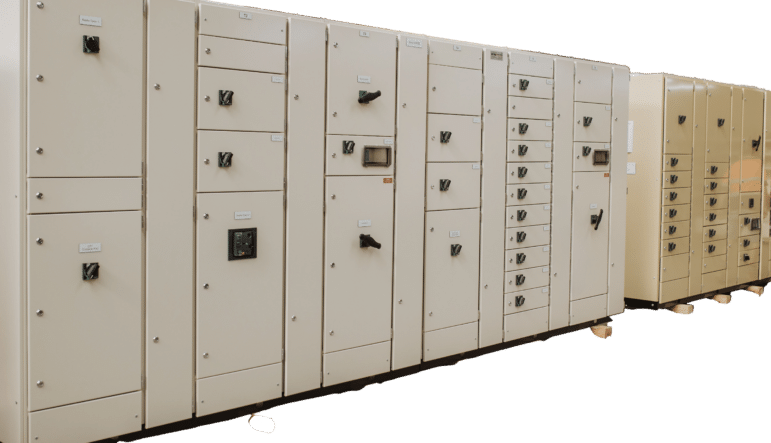
Switchboards
The difference comes down to system role. A main switchboard is usually the primary low-voltage distribution point for a site, while a distribution board is usually a downstream board serving a more local function.
A main switchboard (MSB) usually sits near the top of the electrical hierarchy and distributes power to major loads or downstream boards.
A distribution board (DB) usually sits further downstream and distributes power to smaller areas, local loads, or groups of circuits.
These terms are not just labels. They can affect:
| Topic | Main switchboard | Distribution board |
|---|---|---|
| Usual role | Primary site or building distribution point | Downstream or local distribution point |
| Position in hierarchy | Near the incoming supply or upper distribution level | Further downstream in the system |
| What it typically feeds | Multiple boards, major plant, submains, or larger loads | Local circuits, smaller zones, tenancies, or services areas |
| Typical ratings | Often higher main ratings and busbar capacities | Usually lower than the main board, depending on application |
| Project role | Often central to overall power distribution architecture | Supports local circuit distribution |
| Likely complexity | Often broader protection, metering, or coordination requirements | Usually narrower in scope, but still application-specific |
A main switchboard is typically the principal low-voltage switchboard assembly for a site, building, or major installation zone. It often receives the incoming supply and distributes power onward to downstream boards, major plant, and larger outgoing circuits.
A distribution board is usually a downstream board that distributes power to a defined local area, group of circuits, or smaller section of the installation.
One of the most common misunderstandings is to assume that a large board must be a main switchboard and a small board must be a distribution board.
That is not a reliable rule. A board’s role is better understood by asking:
If a project identifies a board as a main switchboard, the quotation may need to allow for different requirements than a local distribution board. Depending on the project, that could include:
If the board is actually a downstream distribution board, the design basis may be simpler or more localised. Either way, clarity early helps prevent assumption-based pricing.
They often describe different system roles. If the wrong term is used casually, the scope can become unclear.
Function matters more than physical dimensions.
If the quotation package does not explain where the board sits in the system, assumptions are more likely.
Board type should be described alongside main rating, supply details, fault level, outgoing schedule, enclosure requirements, and any special project conditions.
Clive Wilson Switchboards can help review the role, ratings, and practical requirements of a proposed main switchboard or distribution board before the scope is locked in.