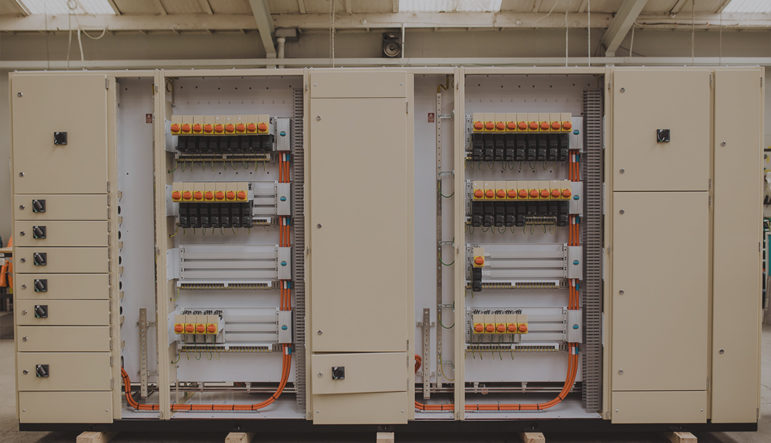
Main Switchboards
Invercargill, New Zealand · ISO 9001 Certified Since 1995
Clive Wilson Switchboards designs and manufactures main switchboards for New Zealand’s most demanding industrial and commercial environments. Every board is AS/NZS 61439 compliant, designed in EPLAN Electric P8, and protection-coordinated with PowerCAD — so you get a board that’s not just built right, it’s provably engineered right.
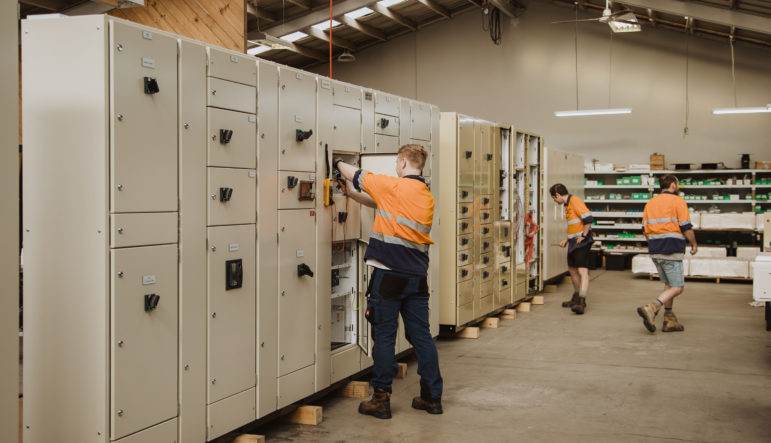
From dairy factories and wastewater treatment plants to data centres and renewable energy projects — if it needs reliable power, we’ve built a board for it. One team, one point of contact, from concept design through to commissioning.
A main switchboard (MSB) is the primary distribution point for a facility’s low-voltage electrical system. It receives the incoming supply from the network or transformer and distributes power safely to every circuit, sub-board, and piece of equipment downstream.
At its core, an MSB contains:
The MSB sets the standard for everything downstream. Get the design right here, and safety, compliance, and lifetime cost improve across the whole installation.
Every project is drawn and documented in EPLAN Electric P8 — the industry-standard platform for electrical panel design. EPLAN generates fully consistent schematics, terminal schedules, cable lists, and bills of materials from a single linked database. No manual drawing errors, faster builds, and clean as-built documentation you can actually use for future maintenance.
EPLAN’s panel layout tools also let us produce a precise digital layout of each board before manufacturing begins — confirming component clearances, busbar routing, and wiring ducts before a single part is ordered.
Cable sizing and protection coordination is verified using PowerCAD — Australia and New Zealand’s leading LV electrical engineering design software. It checks compliance with AS/NZS 3000 and AS/NZS 3008, modelling your distribution network to confirm every protective device correctly discriminates under fault conditions.
For projects requiring formal design sign-off, the PowerCAD report forms part of your compliance package — giving engineers, consultants, and consent authorities a clear, auditable record of the engineering behind your board.
| Component | Function |
|---|---|
| Frame & Enclosure | Powder-coated steel; IP41 to IP55 rated; IK10 impact resistance available |
| Busbar System | Copper busbars rated to 6,300A; horizontal and vertical distribution |
| Incoming Protection | ACB or MCCB with adjustable electronic trip units |
| Outgoing Circuits | MCCBs, MCBs, fuse switches — sized per PowerCAD coordination study |
| Metering & Instrumentation | Multifunction power meters, CT-operated energy metering, protection relays |
| Internal Separation | Form 2B, 3B, or 4B to AS/NZS 61439 — isolates busbars from functional units |
| Arc Flash Mitigation | Restricted earth fault protection, zone-selective interlocking, arc flash detection relay options |
The right fit for commercial buildings, light manufacturing, retail centres, and office parks. These boards typically run at up to 415V AC with outgoing circuits to 1,600A — compact, cost-effective, and designed with future expansion in mind.
Common applications: shopping centres, office buildings, food production facilities, and small-to-medium pumping stations.
Built for environments that can’t afford downtime — dairy factories, wastewater treatment plants, large-scale process facilities. Our heavy industrial MSBs are rated for:
These boards often feed directly into Motor Control Groups or automation panels — which we design and coordinate alongside the MSB as a complete power and control solution.
Every main switchboard we supply is designed, tested, and verified to AS/NZS 61439-1 and 61439-2. That’s not a marketing line — it’s our baseline, with no exceptions.
Our quality process includes:
Safety isn’t an add-on — it’s built into the engineering from day one.
Arc flash is one of the most serious hazards in industrial electrical systems. We carry out arc flash incident energy analysis as part of every engineering package and can incorporate arc flash detection relays, zone-selective interlocking (ZSI), and bus differential protection to minimise both the likelihood and severity of an arcing fault — keeping incident energy levels low and your team safer during live work.
For critical infrastructure and data centre applications, we can specify switchboards with integrated fire detection and suppression provisions — designed to catch internal thermal events early, before they become a serious problem.
We work with project engineers, electrical contractors, and facility managers across New Zealand’s most demanding sectors:
Lead times depend on complexity, current workload, and component availability. For most commercial and light industrial boards, expect 6–10 weeks from confirmed order. Heavy industrial boards with automation integration can run longer. Get in touch early — the more lead time we have, the better we can work around your programme.
Yes. We supply switchboards throughout New Zealand and have commissioned projects across the country, including offshore. If your project is outside the South Island, talk to us — we’ll sort the delivery and commissioning logistics with you.
Absolutely — and we prefer it. If your consulting engineer has produced a switchboard specification or schedule of equipment, send it through and we’ll quote against it directly. We can also work with your engineer during the design phase if the spec is still being developed.
Internal separation defines how well busbars, functional units, and terminals are physically isolated from each other inside the switchboard. Form 4 provides the highest level — busbars, functional units, and terminals are all in separate compartments, which improves maintenance safety and reduces fault propagation risk. We’ll recommend the right form for your environment and application.
We supply boards from small commercial installations up to 6,300A, with fault ratings to 65kA/1s. If you’re unsure what rating your project needs, your electrical designer or network operator can confirm the prospective fault current at the point of supply.
Yes. We offer end-to-end support from concept design and PowerCAD engineering through to EPLAN documentation, factory acceptance testing (FAT), site delivery, and commissioning support. One team, one point of contact, start to finish.
Since 1971. Over 55 years of building switchboards for New Zealand’s toughest industrial and commercial environments — from the deep south to the top of the North Island. Read our story →
Related pages that may help with your project:
Free, no-obligation quotes. Straight answers from our team — not a sales pitch.