
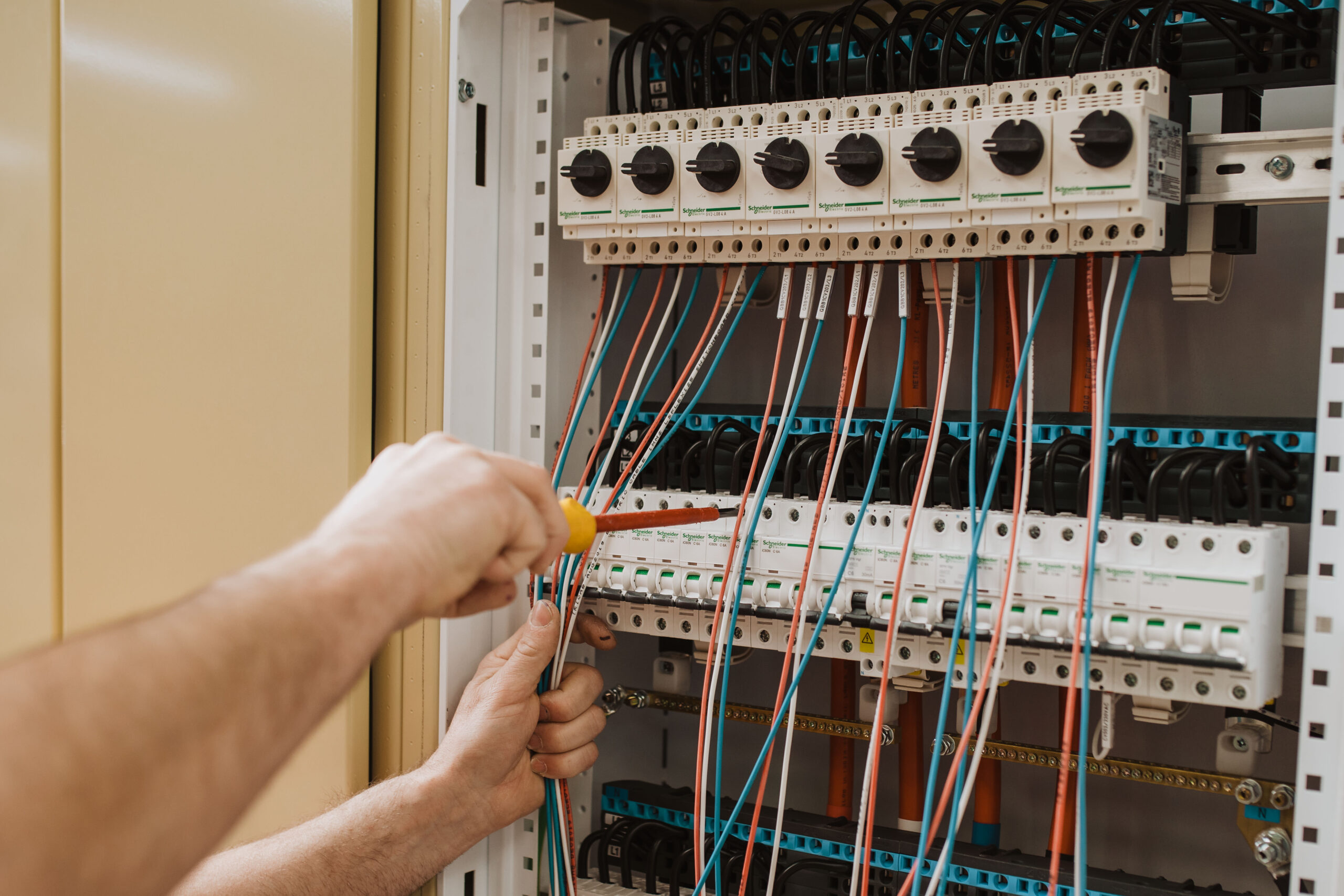
MSB stands for main switchboard in electrical work. It is the principal assembly receiving and distributing supply within an installation. It brings together the required switching, protection and distribution functions, with metering and control where the project needs them.
Where the MSB fits
On a simple site, the main switchboard receives the incoming supply and feeds the building’s circuits or downstream boards. On a larger site, it may distribute to several motor control centres, distribution boards and major loads. Generator, UPS or other supplies can introduce additional sections and interlocking.
The name describes the board’s function, not a universal size or current rating. Some installations have more than one supply arrangement. The MSB versus distribution board guide explains the usual hierarchy without assuming every site follows one pattern.
Inside a main switchboard
- Incoming switching and protection: selected for the supply and protection design. The arrangement is not necessarily the same on every board.
- Distribution conductors: busbars and connections designed for the electrical and thermal duty.
- Outgoing circuits: feeders selected for their loads, cables and coordination requirements.
- Protective and neutral connections: provided and arranged to suit the installation’s earthing and conductor system.
- Enclosure and internal arrangement: protection, access and separation appropriate to the application.
- Identification and documentation: board identity, ratings, circuit references and the agreed records.
Metering, communications, automatic transfer and other functions are specified where needed. They should not be assumed merely because an assembly is called an MSB.
Follow one feeder through the site
Imagine a processing site where the incoming supply reaches the main switchboard, then separate feeders supply a production MCC, a warehouse distribution board and a packaged refrigeration system. The MSB gives those downstream systems their supply connection and the switching and protection functions established by the design.
The MCC then deals with individual production motors. The warehouse board supplies its local circuits. Refrigeration controls may be supplied by the equipment vendor. This example shows why the MSB schedule needs to identify each downstream duty without treating every outgoing circuit as the same kind of load.
It also exposes the boundaries between packages. The MSB manufacturer needs the relevant feeder requirements, while the installation designer coordinates the cables, protection and overall supply arrangement. A clearly labelled single-line diagram helps everyone work from the same architecture.
For a built example of the main-board and downstream-board relationship, see Southern Charity Hospital in Invercargill. CWS manufactured the Form 4 main switchboard and distribution boards within the hospital’s supply package.
Read the ratings as a set
| Item | Meaning for the project |
|---|---|
| Current duty | The load and operating conditions the assembly must accommodate. |
| Short-circuit duty | The declared capability at the required fault conditions, with duration or conditions where relevant. |
| IP rating | The defined degree of enclosure protection against ingress. |
| Separation | The specified internal arrangement between busbars, units and terminals. |
| Service conditions | The environment and installation assumptions supporting the design. |
These items cannot be traded casually. A larger incomer does not establish a higher assembly rating, and a higher IP number does not prove that the enclosed equipment can operate at the required temperature. Read the nameplate, approved drawings and supporting information together.
How the design is established
The loading schedule and operating modes establish the current duty. The fault study and protection strategy establish the short-circuit requirements. Environmental conditions and access then influence the enclosure, internal layout and cooling.
CWS considers Simotrol, Logstrup and Schneider Prisma arrangements against the specific application. A platform’s published maximum does not mean every configuration can carry that rating in every environment.
Do not assume an MSB always has the highest fault level on a complex site. Parallel sources and local generation can change the conditions at different points. Use the project study.
Why physical layout matters as much as the circuit list
Check how the board reaches the switchroom before settling the overall dimensions. Doorways, corners, floor capacity, lifting arrangements and transport sections can affect the proposal. At the final position, the installer needs room for the actual incoming and outgoing cables, not just the cable sizes written on a schedule.
Operations also need a usable arrangement for normal controls and planned maintenance. Identify essential circuits clearly and agree how future additions will be accommodated. Spare floor space, spare circuit ways and electrical capacity are different allowances; each should be stated.
For a replacement board, establish whether existing cable positions constrain the new layout. That assessment often needs verified site information before manufacturing drawings can be finalised.
Buying or replacing an MSB
For a manufacturing enquiry, visit our main switchboards page and send the available single-line diagram, load schedule and site constraints. The cold-storage MSB project shows how refrigeration feeders and downstream distribution were coordinated in one assembly.
Send a single-line diagram, outgoing schedule, supply information, available space and delivery requirements. For an existing installation, add current drawings, cable details, photographs and the intended shutdown scope.
Agree the drawing approvals, verification records and functional testing before manufacture. A factory-tested board still needs correct installation, site verification and commissioning. The responsible parties and handover boundaries should be clear.
CWS manufactures main switchboards in Invercargill for projects across New Zealand. If the board is part of a live facility, use the upgrade and replacement planning guide to prepare for de-energised changeover work.
Questions we hear
Is an MSB the same as a meter box?
Not necessarily. Metering may be within or separate from the main switchboard. The MSB’s role is the installation’s principal switching and distribution arrangement.
Can an MSB also feed final circuits?
Yes. A smaller installation may combine incoming switching and final-circuit distribution in one assembly. The design and applicable requirements must suit that use.
What should I send for pricing?
The single-line diagram, outgoing schedule, available supply and fault information, enclosure requirements, physical constraints and programme.
Does a larger incoming breaker increase the MSB rating?
Not by itself. The assembly, conductors, protective devices, temperature rise and verification basis must support the proposed duty. A change needs assessment.