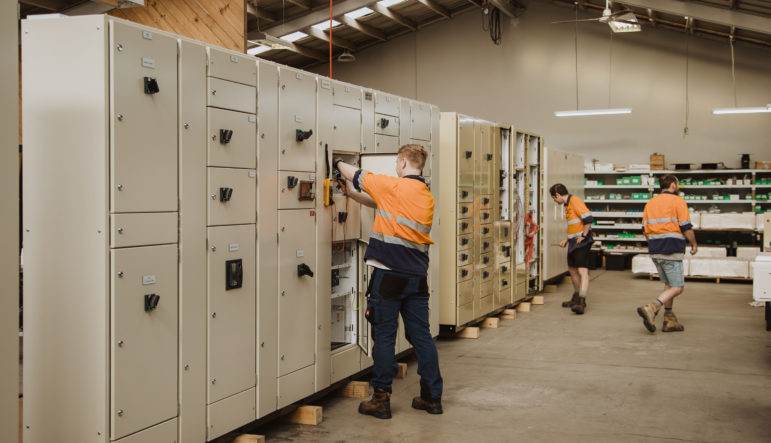
A switchboard is one of the most critical assets on any industrial site and one of the most often neglected. When it works, nobody notices. When it fails, the whole plant stops. A simple maintenance schedule prevents most of the failures we see in the field.
Quick answer
An industrial switchboard needs visual checks monthly, thermographic imaging annually, full insulation resistance and torque-check every 2 to 3 years, and a comprehensive de-energised overhaul every 5 years. Schedule maintenance windows in advance, work to AS/NZS 3000 and AS/NZS 3760, document every visit, and act on thermal hotspots before they fail.

In this article
This guide covers what is actually inside an industrial switchboard, why most failures are preventable, what a practical maintenance schedule looks like for NZ industrial sites, and what to plan for when an existing board is approaching end of life. Clive Wilson Switchboards, based in Invercargill, has been servicing and replacing LV switchboards across New Zealand for over 55 years.
Most facility managers think of the switchboard as a closed metal box on the wall. What is actually inside it is the live heart of the electrical installation. Every component carries some part of the load, and every connection is a potential failure point.
Each one of these has a maintenance need. Torque drift, insulation degradation, dust and humidity, vibration, thermal cycling and corrosion all chip away at the assembly’s margin of safety over time.
Three reasons account for almost every neglected maintenance programme we see in the field.
A practical maintenance schedule for an industrial NZ switchboard has four tiers, each tied to an interval and a level of intervention.
Annual thermographic imaging is the highest-value maintenance any site can do. It takes an hour, requires no outage, and catches the connections that are about to fail before they actually do.
If a board is more than 30 years old, has obsolete protection relays, missing as-built drawings, or has been the subject of repeated failures, the maintenance conversation moves into a replacement conversation.
For replacement planning, our switchboard upgrade and replacement guide covers what to capture before tendering and how to plan the changeover.
A practical baseline is monthly visual checks, annual thermographic imaging, a 2 to 3 year de-energised service with insulation resistance testing and torque checks, and a comprehensive 5 year overhaul. Harsh environments and high-duty applications shorten those intervals.
Thermographic imaging uses an infrared camera to survey the switchboard while it is in service at full load. Loose connections, overloaded circuits and developing faults show as thermal hotspots well before they cause an outage.
AS/NZS 3000 for installation, AS/NZS 3760 for in-service testing and inspection, and the assembly’s original AS/NZS 61439 type-test envelope for any work that affects the rated current, fault rating or form of internal separation.
When spare parts are no longer sourceable, when the original type-test envelope no longer matches current AS/NZS 61439 requirements, when fault rating is inadequate for the current site PSCC, or when repeated failures indicate the assembly is past its service life.
Yes. Our maintenance and inspection services cover any LV switchboard on an NZ industrial site, regardless of who built it. Where parts are obsolete or the original verification envelope cannot be confirmed, we will flag that in the report and recommend a replacement plan.
Reviewed by Chris Wilson, Co-Director, Clive Wilson Switchboards. Registered electrician, 15+ years in LV switchboards. Updated May 2026.