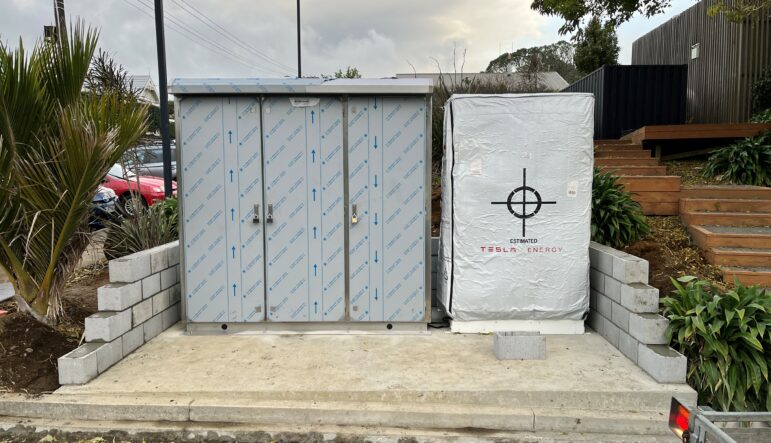
Commercial and industrial EV charging is a different problem to residential charging. Loads are higher, sites are more demanding, downtime costs revenue, and the switchboards behind the chargers do most of the heavy lifting that public users never see.
Quick answer
Commercial and industrial EV charging projects in NZ need custom switchboards sized for the actual charger load (AC chargers from 7-22 kW, DC fast chargers from 50 kW upward), built to AS/NZS 61439, with the upstream feeder and supply fault rating coordinated to handle continuous high duty. CWS has built switchboards for public charging networks, including Tesla Supercharger sites.

In this article
This guide covers what makes commercial and industrial EV charging different, who is building it, what the underlying switchboard requirements look like, and the mistakes we see on projects across NZ. Clive Wilson Switchboards builds EV charging infrastructure switchboards for public, commercial and industrial sites nationwide.
A home wallbox runs at 7 kW, draws single-phase, and operates intermittently. A commercial charging site runs DC fast chargers at 50 kW and up, draws three-phase, and operates continuously at high duty. The infrastructure underneath is completely different.
We build the switchboard infrastructure that sits behind commercial chargers. That includes:
Recent project work includes switchboards for public Tesla Supercharger sites and other commercial fast-charging networks across New Zealand. We understand what high-demand, high-reliability charging infrastructure requires at the switchboard level, and we build it in-house in Invercargill to the same AS/NZS 61439 standard as our industrial MSBs.
DC fast chargers operate near their rated power for sustained periods. The diversity factor that applies to a normal commercial load does not apply to charging infrastructure. Size the switchboard and the feeder to the continuous cumulative charger load, not to a discounted figure.
Larger sites running multiple high-power chargers usually need a dedicated transformer or a significant upstream upgrade. Coordinate the switchboard fault rating with the network operator’s fault contribution at the point of supply.
DC chargers are non-linear loads. They produce harmonic currents that can affect upstream equipment and other tenants on the same supply. Plan for harmonic mitigation and confirm power quality requirements with the network operator early.
Outdoor charging kiosks need weather-rated enclosures with the right IP rating for the installation environment, sized for the heat dissipation of the charger and its supply switchgear. See our IP rating guide.
Most commercial sites grow their charger count over time. Specifying spare busbar capacity, spare breaker positions and ducting space for future feeders at the original build avoids a switchboard replacement at year three.
EV charging projects fail at the switchboard, not at the charger. Get the supply infrastructure right and the chargers stay running. Get it wrong and the chargers spend half their life under fault or sagging supply.
No. We supply the switchboard infrastructure that sits behind the chargers: the supply switchboard, the kiosk enclosure, the protection and metering. The chargers themselves are supplied by the network operator or the project team.
Yes. We have built switchboards for multiple public Tesla Supercharger sites in New Zealand, along with switchboards for other commercial fast-charging networks.
It depends on the charger lineup. A small workplace site with two AC chargers may sit under 100 A. A public DC fast-charging site with multiple 50 kW or higher chargers can need 400 A to 800 A or beyond, plus appropriate fault rating coordinated with the upstream supply.
Yes. We build outdoor-rated kiosk enclosures for public charging sites, with appropriate IP rating, vandal resistance and heat dissipation for the charger and switchgear inside.
Lead times mirror other custom switchboards: 4 to 6 weeks for mid-size, longer for multi-bay public sites with complex coordination. See our lead time guide.
Reviewed by Chris Wilson, Co-Director, Clive Wilson Switchboards. Registered electrician, 15+ years in LV switchboards. Updated May 2026.