
CWS uses Schneider Prisma Plus G for distribution and MSBs up to 630 A, Simotrol as its primary industrial MSB and MCC platform, and Logstrup where higher-current or withdrawable arrangements suit the project. Start with the circuit duties, required capacity and maintenance plan.
Start with the application
CWS is an accredited Schneider Prisma Plus G builder. Prisma Plus G suits distribution and MSB applications up to 630 A. Simotrol is manufactured in-house for industrial main switchboards and motor control centres, with capacity up to 1.5 MVA.
Simotrol options include Form 4a separation, group starter tiers using Form 3bih, 750 A and 950 A vertical busbars, and short-time withstand configurations of 50 or 63 kA for one second. The selected arrangement determines the declared ratings.
See the Simotrol capability page and Prisma Plus G service for the platform details.
Compare the CWS platforms
| Platform | Where it fits | What to specify |
|---|---|---|
| Schneider Prisma Plus G | Distribution and MSBs up to 630 A, built by CWS as an accredited Prisma builder. | Circuit schedule, mounting, protection and enclosure requirements. |
| Simotrol | Our primary industrial MSB and MCC platform, manufactured in-house, with capacity up to 1.5 MVA. | Supply, motor duties, starter arrangement, form, fault duty and drive heat. |
| Logstrup | Modular assemblies with capability up to 8,000 A and fixed or withdrawable configurations. | Required current, unit connections, withdrawal positions, handling space and spares. |
Custom dimensions and interfaces are requirements to resolve within the selected assembly design. They are not a separate CWS platform.
Ask for the evidence behind the proposed platform
A brochure helps identify a platform route. For procurement, connect each proposed characteristic to the actual configuration and supporting record. CWS’ 2026 Simotrol profile is a starting reference, with final project evidence confirmed in the proposal.
| Characteristic | Record to request | Why the distinction matters |
|---|---|---|
| Current and fault duty | Declared assembly ratings, conditions and the matching design-verification basis. | A device rating or a headline platform maximum does not establish the whole board’s duty. |
| MCC form and modules | Configuration drawing, selected functional units and terminal arrangement. | MCC-specific published options do not automatically describe every MSB. |
| Environment and cooling | Enclosure details, equipment instructions and the proposed thermal basis. | IP classification alone does not settle temperature, corrosion or condensation suitability. |
| Future additions | Supported extension arrangement, spare duty and retained original records. | Physical room does not prove usable electrical or thermal capacity. |
For withdrawable construction, compare the actual manufacturer’s unit arrangements and the maintenance and configuration questions. Confirm each proposed drawing rather than inferring operation from a platform name.
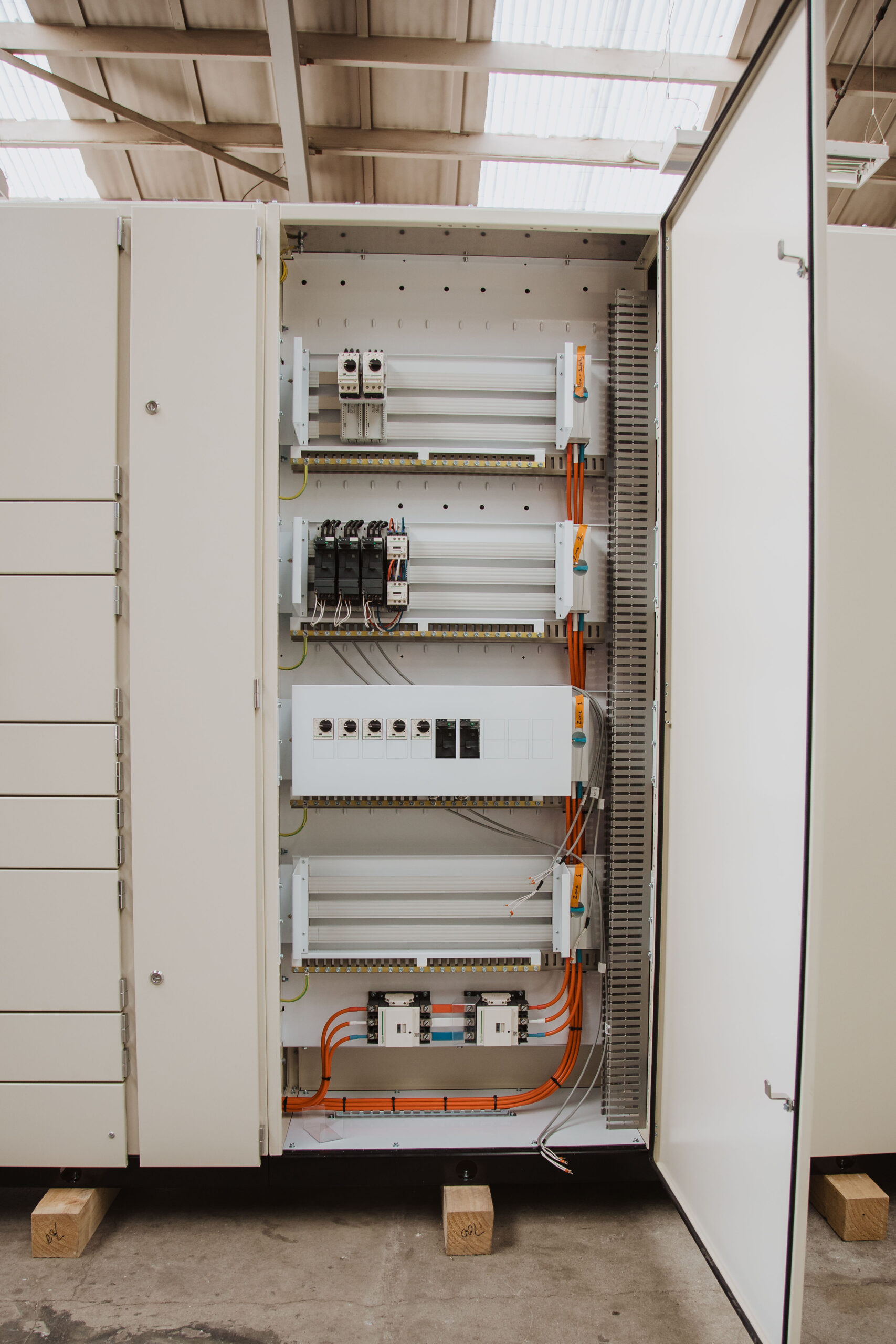
The information that decides the choice
- Confirm the load, operating modes and fault duty.
- Define the circuit schedule, starting methods and controls.
- Resolve form, access, cable space and maintenance tasks.
- Set the environment, temperature and enclosure requirements.
- Check footprint, transport splits and future expansion.
- Compare equipment availability, documentation and the project programme.
Choose the configuration that fits the duty, available space and maintenance plan. State any required brand or permitted alternative in the enquiry.
Expansion needs more than spare floor space
If later extension is intended, state the future load and circuit types now. The design must consider busbar and protection capacity, thermal duty, cable access, verification and the physical connection arrangement.
Adding a section requires a check of the existing busbars, incomer, thermal capacity and supported extension arrangement. Plan the shutdown and keep the original drawings with the board records.
Request a comparable proposal
Send the single-line diagram, schedule, fault requirements and available dimensions. If the specification names a platform, state whether equivalent alternatives are permitted and how they will be evaluated.
Ask for the proposed ratings, verification basis and layout showing cable space and access. We will include the platform and current delivery programme in the proposal.
Questions we hear
Is Logstrup only for very large MSBs?
No. Suitability depends on the required configuration and functions, including any withdrawable arrangement, as well as current.
Does a platform certificate cover every possible board?
No. The completed assembly must remain within an appropriate verified design and be subject to the required routine verification.