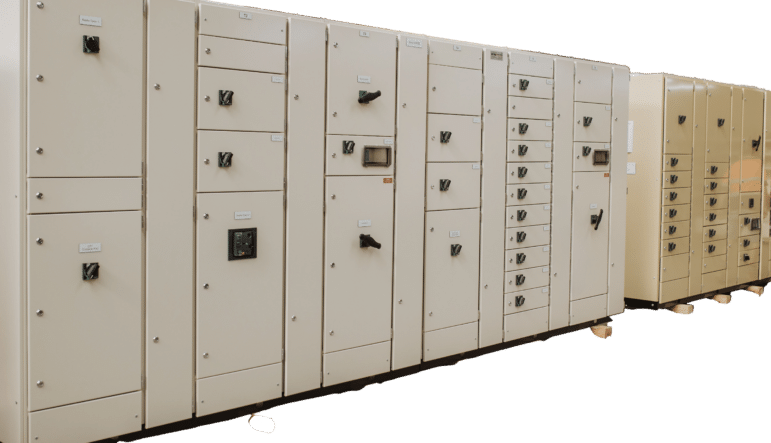
Main switchboards and distribution boards sit at different points in the same electrical system and do different jobs. They look similar, share the same standards, and even share components. But specifying one when you need the other is a costly mistake.
Quick answer
A main switchboard (MSB) sits at the utility intake, carries the highest current and fault rating on the site, and distributes feeders to MCCs, sub-mains, distribution boards and large single loads. A distribution board (DB) sits downstream of the MSB, distributes power to final circuits and small loads, and carries a lower current and fault rating. MSBs are floor-standing power assemblies; most DBs are wall-mounted.

In this article
This guide explains where the main switchboard and the distribution board sit in the electrical chain, what each does, how they differ in size and rating, and which one a specific project needs. Clive Wilson Switchboards builds both for industrial and commercial NZ sites.
The main switchboard sits at the supply intake, fed directly from the utility transformer. Everything in the installation draws its power through the MSB. Downstream of the MSB sit sub-mains, MCCs and distribution boards. Each of those serves a section of the site.
A distribution board takes a single feeder from the MSB or a sub-main and distributes it across final circuits, lighting circuits, socket outlets and small fixed loads. A typical industrial site has one MSB and multiple DBs scattered through the building.
Any new electrical installation at the utility intake needs an MSB. Each downstream zone or section of a building that has more than a handful of final circuits typically needs a DB to serve that zone.
A small commercial fit-out may have a single MSB-DB hybrid where the supply current is modest. A large industrial site has one MSB at the intake, multiple sub-main distribution feeders, and DBs at every plant area and zone.
For a deeper look at MSBs specifically, see our explainer What Is a Main Switchboard? For motor-rich plants where the question is MSB vs MCC, see our MSB vs MCC comparison.
If you are buying one board, you almost always need both: an MSB at the intake and DBs at each downstream zone. The mistake is treating them as interchangeable; they sit at different points and carry different ratings.
On small commercial sites where the supply current is modest, a single board can act as both the supply intake and the final-circuit distribution point. For anything larger than a small commercial fit-out, separating the MSB and downstream DBs is the standard approach.
Both are designed and verified to AS/NZS 61439. The MSB falls under Part 2 (power switchgear and controlgear assemblies); smaller DBs may fall under Part 3 (distribution boards intended to be operated by ordinary persons).
Most NZ commercial DBs are Form 2 or Form 3. Lower forms are used where downtime tolerance is high. See our form of segregation guide.
Yes. Schneider Prisma Plus G covers both ends, MSBs and DBs, which gives a consistent look, consistent spares pool and consistent maintenance approach across the site.
DBs are typically faster, three to four weeks for a standard build with complete information. MSBs run four to six weeks for mid-size, longer for large or complex builds. See our lead time guide.
Reviewed by Chris Wilson, Co-Director, Clive Wilson Switchboards. Registered electrician, 15+ years in LV switchboards. Updated May 2026.