
Motor control centres.
Built in NZ.
Custom motor control centres manufactured in Invercargill for New Zealand process plants, water infrastructure and industry. Simotrol motor feeders, starter arrangements and PLC interfaces configured around your motor schedule and operating duty.
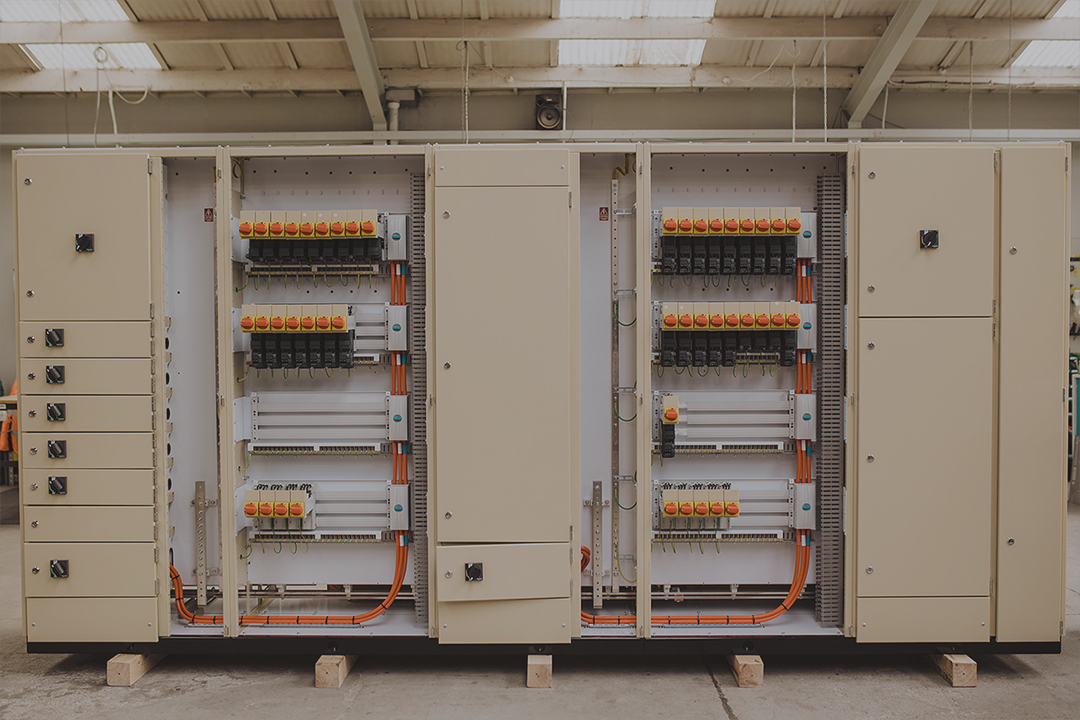
Explore a completed 630 A process MCC with assigned motor duties, fitted spares and space for future circuits.
Start with the operating duty.
Simotrol is our primary MCC platform. We configure the assembly around the motor duty, fault level, separation and maintenance requirements of your plant.
On smaller screens, scroll across the table to see every column.
| Platform | Current & fault rating | Arrangement | Project selection |
|---|---|---|---|
| Simotrol | Up to 2,500 A Icw 50 or 63 kA for 1 second | Form 3b or 4a Demountable options | Ratings and compartment arrangement confirmed for the specified assembly. |
| Logstrup | Project-specific declared ratings | Fixed and withdrawable configurations | Selected around the required feeder arrangement, access and continuity of service. |
Final ratings depend on the assembly configuration, installed equipment and verification documentation. Specify the prospective fault current and required withstand duration with your enquiry.
Match the starter to the motor.
Starting duty, process control and the available supply determine the feeder arrangement.
On smaller screens, scroll across the table to see every column.
| Arrangement | Typical reason to consider it | What the design brief needs to address |
|---|---|---|
| Direct-on-line (DOL) | Fixed-speed duty where the supply and driven equipment can accommodate direct starting. | Starting current, acceleration, switching frequency, overload protection and local or remote control. |
| Soft starter | Controlled acceleration for an application that normally runs at mains frequency. | Starting torque, start duration, starts per hour, stopping requirements and internal or external bypass arrangements. |
| Variable speed drive (VSD) | Speed adjustment during normal operation, such as matching a pump or fan to process demand. | Duty and overload requirements, motor cable, cooling, EMC, harmonics, communications and any separately engineered bypass. |
Work through the interfaces.
A useful specification considers the complete installation, from incoming protection to field connections.
Protection and coordination
Review the short-circuit protective device, contactor, overload function and starting equipment as a combination. A high interrupting rating on one breaker does not establish the rating of every downstream device or the complete MCC.
Provide the available fault level, upstream protection and any specified coordination or discrimination requirements. Manufacturer selection and coordination data form part of the equipment review.
Control and feedback
Define the difference between a start command and proof that the motor is running. Typical interface questions include local or remote selection, run feedback, trip indication, reset, permissives and speed reference.
The automation and control scope should identify what happens on communication loss and who is responsible for the PLC software, field wiring and final sequence testing.
Heat and enclosure conditions
Drive losses, starter duty, ambient temperature and the enclosure arrangement affect the thermal design. Include altitude or unusual site conditions where relevant. Bypass operation may reduce a soft starter’s running losses, but it does not remove the need to assess starting duty and the rest of the assembly.
Cables, segregation and expansion
Allow for motor-cable sizes, gland space, power and control wiring routes, and practical access to terminals. Spare installed feeders, empty module spaces and space for a future extension are different provisions and should be identified separately.
The form of internal separation should follow the specified arrangement. Additional arc-fault performance, where required, needs its own stated evidence and scope.
Check the assembly.
Record the result.
Agree the factory acceptance test scope before manufacture. Project checks can include:
- Assembly inspection, identification and drawing checks.
- Wiring continuity and protective circuit checks.
- Control circuit and functional operation checks.
- Feeder interlocks, indications and interface checks.
- Test records and documentation for handover.
Assembly verification, factory acceptance testing and site commissioning are distinct activities. The project specification defines the required scope.
Give us the motor list.
An early schedule helps us understand the feeders, controls and space the MCC needs.
Include motor kW and full-load current, starting method, duty, control and feedback requirements, communications, spare feeders and future capacity.
Add the single-line diagram, site fault level, cable entry requirements and available dimensions where known.
Open the template in Excel, add your motors and send it with your project drawings.
Can we allow for future motors?
Include expected future loads and spare feeders in the brief. Busbar capacity, compartment space and cable zones can then be considered together.
What about VSD bypass and interlocks?
Set out the required operating modes and maintenance arrangements. Bypass, isolation and interlock requirements are coordinated with the feeder design.
How are PLC interfaces handled?
Provide the I/O schedule and control philosophy where available. Panel wiring, terminal arrangements and communications are coordinated with the project control-system team.
From motor schedule
to a complete assembly.
A 630 A Simotrol MCC with direct-on-line starters, VSD supply feeders, auxiliary distribution and identified future provisions. See how the equipment is arranged across three sections in our anonymous industrial project case study.
See the industrial process MCC buildLet’s work through
your MCC specification.
Send the motor schedule, drawings and known site requirements. We can help define the assembly and the information needed to quote.
Printable quote checklist (PDF)Email your checklist, drawings and schedules to estimating@clivewilson.co.nz. Leave unknown items blank.
Discuss your projectOr call +64 3 214 4264Specify the technology your board needs.
Explore arc-flash protection, temperature monitoring, fire-system integration and connected metering options.
Explore switchboard technology